
Elementor Website Design
Elementor is only as good as the person building in it. I design and build Elementor sites that stay fast, stay consistent as they grow, and are simple enough for your team to update. Fixed price agreed before we start, and the whole thing is yours at handover.
Elementor Pro specialist · 6 years, Top Rated on Upwork
Three Ways To Work
Most people arrive here in one of three situations: starting fresh, unhappy with how an Elementor site looks, or stuck with one that has become slow and unmanageable. All three are fixable, and they cost very different amounts.
Most popular
Designed and built from scratch in Elementor Pro with a proper design system behind it: global tokens, Theme Builder templates and dynamic content from day one.
Best when you are starting fresh or replacing something that no longer represents you.
Budget friendly
Import an Elementor kit or template you like, then rebuild it around your business: your colours and fonts wired to global styles, unused sections removed, demo bloat stripped out.
Best when budget or timeline is tight, or you have already found a layout that fits.
Fix what you have
An existing Elementor site that is slow, inconsistent or terrifying to edit. I audit the addon stack, consolidate styles into globals, rebuild the worst templates and cut the load.
Best when the site works commercially but has become a liability to run.

The Real Problem
The usual pattern: four or five addon plugins installed for one widget each, every page hand-built rather than templated, styling set widget by widget instead of globally, and a stack of scripts loading on pages that never use them.
None of that is Elementor. It is what happens when a site grows without a system behind it. Fixing it is mostly subtraction: consolidate styles into globals, replace addon widgets with core ones or a few lines of CSS, template anything repeated, and stop loading assets where they are not needed.
If speed is your only concern and the design is fine, say so. Sometimes a speed pass is a better use of your money than a rebuild.
What's Included
One source of truth for every colour and type style. Change a brand colour once and it updates everywhere, instead of hunting through forty widgets.
Header, footer, archives and single templates built once and applied by display condition, so the site stays consistent however many pages you add.
Loop Builder and custom fields for anything repeatable: projects, services, locations, team. Add an entry and the listings, filters and templates update themselves.
As few addon plugins as the design genuinely needs, and I will tell you which ones and why. Custom CSS where it beats installing something.
The Process
You get a fixed quote and a written scope before anything starts. Every stage has a clear deliverable, so you always know where the project is.

Step 01
If you have an existing Elementor site, I audit the addon stack, template structure and load first. If you are starting fresh, we scope what the site needs to do. Either way you get a fixed quote in writing.
Step 02
Global colours, typography scale and spacing agreed before pages are built. This is what keeps an Elementor site consistent, and it is what almost every slow build skipped.
Step 03
Header, footer and any archive or single templates built in Theme Builder, then the key pages designed on top. Reviewed on a staging link with two rounds of revisions included.
Step 04
Remaining pages built from the templates, then a deliberate cleanup pass: unused addons removed, styles consolidated, assets deferred, Core Web Vitals measured before launch rather than after.
Step 05
Redirects mapped if we are replacing an existing site, then full access, files and written documentation. Including a short guide to editing your own Elementor templates without breaking them.
Selected Work
Life Sciences · Gated Supply Platform
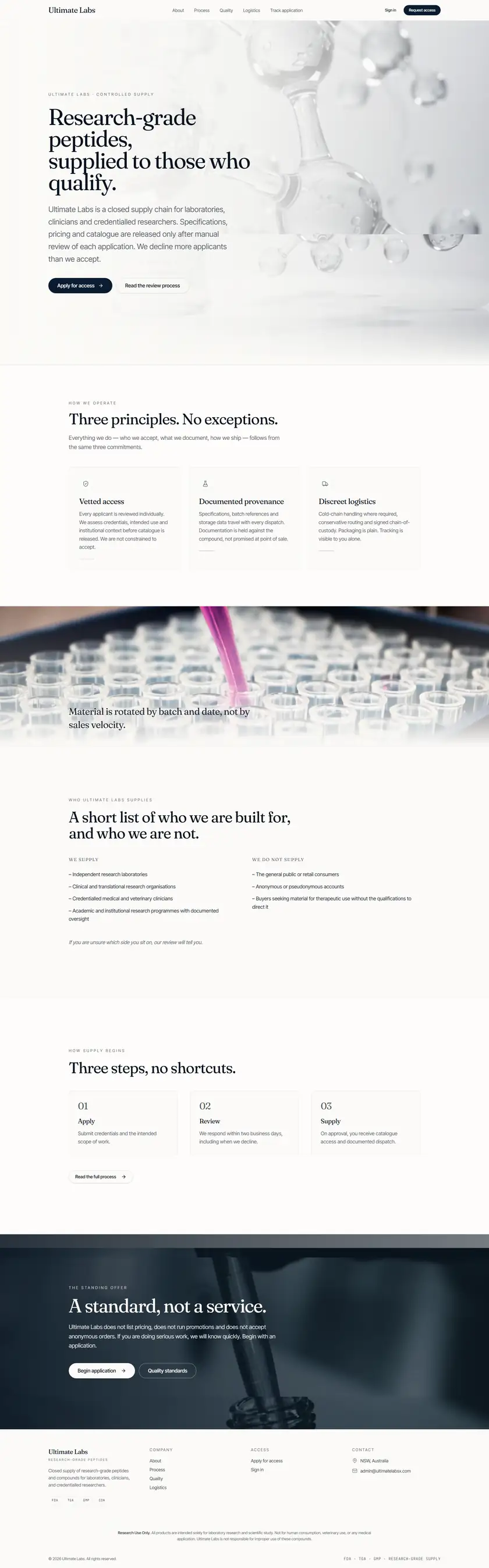
E-Commerce · Pet Food Subscription

Questions
Not by itself. Elementor adds some overhead, but the sites people complain about are usually slow for other reasons: several addon plugins each loading their own CSS and JavaScript sitewide, uncompressed images, no caching configuration, and styling applied widget by widget instead of globally. A carefully built Elementor site passes Core Web Vitals comfortably. A carelessly built one on any platform will not.
Most business sites need Pro, because Theme Builder, Loop Builder and the form widget are Pro features and they are what make a site maintainable. The licence is bought in your name so you own it, typically around the cost of a single hosting year. If your project genuinely does not need those features I will say so rather than sell you a licence you will not use.
Yes, and it is often cheaper than starting again. I audit what is installed, consolidate scattered styling into global colours and fonts, replace addon widgets with core equivalents or custom CSS, template anything that repeats, and strip out plugins that are earning nothing. You keep your content and your URLs.
Elementor when the design needs fine control, or the site relies on dynamic content and custom templates. Kadence when raw loading speed matters most and the layout is more straightforward. I build in both and will recommend whichever suits the project rather than defaulting to one. If you already have a preference, I will work with it.
Yes, and that is a design goal rather than an afterthought. Content lives in clearly named fields, repeated elements come from templates so you cannot break the layout by editing one page, and you get written documentation covering the changes you are most likely to want to make.
As few as the design genuinely needs, and I will tell you which and why. Most Elementor sites carry three or four addon packs for a handful of widgets, each loading assets on every page. Where a widget can be replaced with core Elementor plus custom CSS, that is usually the better trade.
Yes. Product archives, single product templates, cart and checkout can all be built in Elementor Pro. For large catalogues I will be honest about where Elementor stops being the right tool and a more specialised setup would serve you better.
A standard business site of five to ten pages usually takes three to five weeks from approved scope. Customising an existing kit is faster, often two to three weeks. A rescue job on an existing site depends entirely on what is under the bonnet, which is why I audit before quoting.
They should hold. Every existing URL is mapped, 301 redirects are set, title tags and metadata that already perform are preserved, and the content earning your traffic stays. I check indexing and crawl errors in Search Console after launch rather than assuming it went fine.
Yes. The Elementor licence is in your name, all templates and files are yours, and nothing is licensed back to me. Any Elementor developer can pick the site up, which is the point of building it with a proper system rather than a pile of one-off pages.
Next Step
If you already have an Elementor site, send the link and I will come back with what is slowing it down and what it would take to fix. If you are starting fresh, a sentence about the project is enough. Reply within 24 hours, and I will say so if I am not the right fit.
Typical reply time: under 24 hours

WordPress developer & SEO specialist from Bahawalnagar, Pakistan, serving businesses and agencies worldwide.
Available for remote projects
© 2026 Shahzad Ishaq. Built with WordPress in mind, designed to convert.