

For most small business websites, a freelance WordPress developer is the better choice: the same platform, direct contact with the person actually building it, and typically three to ten times less than agency pricing. An agency earns its premium on large or complex projects, where several stakeholders, real integrations or a migration with rankings at stake need managing alongside each other. The deciding factor isn’t budget. It’s how many moving parts your project has.
I’m a freelance WordPress developer, so you should read the rest of this with that in mind. I’ve tried to write the article I would want to read if I were the one hiring, which means it includes the situations where you shouldn’t hire someone like me.
Table of Contents
- Quick comparison
- Decide in 60 seconds
- What you’re actually buying
- The cost comparison, honestly
- The five real risks of hiring a freelancer
- The four real risks of hiring an agency
- When an agency is the right call: large and complex projects
- When a freelancer is the better choice
- What about Upwork, Fiverr and in-house?
- Questions to ask either one
- What I charge
- The verdict
- Frequently Asked Questions (FAQ)
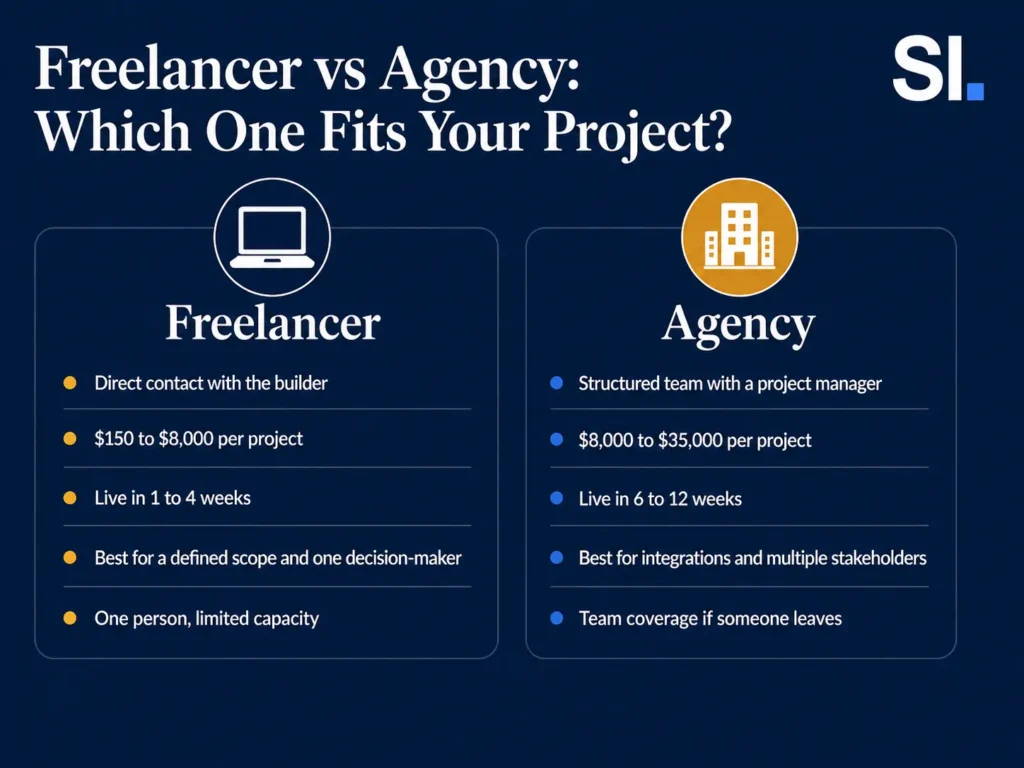
Quick comparison
| Freelancer | Agency | |
|---|---|---|
| Typical project cost | $150 to $8,000 | $8,000 to $35,000 |
| Hourly rate | $25 to $150 | $100 to $250 |
| Who you talk to | The person building it | A project manager |
| Timeline, 8-page site | 1 to 4 weeks | 6 to 12 weeks |
| Specialists included | One generalist | Designer, developer, PM, strategist |
| Availability | Limited, one person | Team coverage |
| If they vanish | Project stalls | Someone else picks it up |
| Strategy included | Rarely | Usually |
| Best at | Defined builds, fixes, speed | Complex builds, migrations, scale |
| Worst at | Multi-stakeholder projects, scale | Small budgets, fast turnarounds |
The cost gap is real but it’s not the whole story, and treating it as the whole story is how people end up paying twice.
Decide in 60 seconds
Score one point for each statement that’s true of your project.
Points toward an agency:
- More than two people have to approve the design.
- The site connects to a CRM, ERP, booking system or custom API.
- You’re migrating an existing site with meaningful search traffic.
- You need copywriting, branding or photography as well as a build.
- Downtime or a launch delay would cost you real money.
- You expect the scope to change during the project.
- You need a signed SLA or procurement-approved contract.
Points toward a freelancer:
- You can describe what you want in a single page.
- One person makes the final call.
- You already have your content, or can write it.
- Your budget is under $5,000.
- You want it live in weeks, not months.
- You want to talk to the person actually building it.
- The site is a brochure, portfolio, or straightforward store.
Four or more agency points: hire an agency. The coordination cost is real and a freelancer will drown in it.
Four or more freelancer points: hire a freelancer. An agency will charge you for project management you don’t need.
Split evenly: hire a freelancer for the build and buy strategy separately. It’s usually cheaper than buying both from one place, and you keep the option to change your mind.
What you’re actually buying
A freelancer
One person doing design, build, and launch. Their rate reflects their own time and nothing else, which is why the number is lower. There’s no office, no account manager, no bench of staff between quotes.
What you get is directness. The person who understands your project is the person answering your messages, so nothing is lost in translation and decisions happen in one exchange rather than three.
What you don’t get is capacity. A freelancer with four clients can’t start yours next week. A freelancer who gets ill delays your launch. A freelancer who is excellent at development may be mediocre at design, and you won’t always know which until you see the work.
An agency
A team, usually with a project manager sitting between you and the people building. Rates run roughly two to three times a freelancer’s because you’re paying for that structure: overhead, coverage, process, and the ability to put four people on a problem.
What you get is reliability and range. Someone is always available. There’s a process for scope changes and a contract that survives one person leaving. Specialists genuinely do produce better work in their specialism.
What you don’t get is speed or cheapness. A change that takes a freelancer twenty minutes takes an agency a ticket, a sprint slot and an invoice line. For a small project, most of what you pay for is coordination you didn’t need.
The cost comparison, honestly
Rates vary far more by geography than by skill, which almost no comparison article says out loud.
| Supplier type | Hourly rate | 8-page site | Where |
|---|---|---|---|
| Marketplace freelancer | $15 to $40 | $150 to $800 | Global, mixed quality |
| Independent freelancer, South Asia | $15 to $40 | $200 to $1,500 | Pakistan, India, Bangladesh |
| Independent freelancer, Eastern Europe | $30 to $70 | $1,200 to $3,500 | Poland, Ukraine, Romania |
| Independent freelancer, US / UK / AU | $60 to $150 | $2,500 to $8,000 | Higher cost of living |
| Small studio, 2 to 5 people | $75 to $150 | $5,000 to $15,000 | Varies |
| Full agency | $100 to $250 | $8,000 to $35,000 | Mostly US and Western Europe |
The same eight-page WordPress site appears at $300 and at $30,000 in this table. The build isn’t a hundred times better at the top. What scales is the amount of thinking, coordination and risk transfer bundled with it, and the cost of living where the supplier lives.
That matters when you compare quotes. A low rate from a different economy isn’t a warning sign. A low rate with a vague scope is, regardless of where it comes from.
For a full itemised breakdown of what the software itself costs on top of the build, see how much a WordPress website costs in 2026.
The five real risks of hiring a freelancer
These are the fears buyers have and rarely say out loud. They’re legitimate, and each one has a specific fix.
1. They disappear mid-project.
Protect yourself with structure, not trust. Pay in milestones, never fully upfront. A typical split is 30% to start, 40% at design approval, 30% at launch. You should also hold your own domain and hosting accounts from day one, so that if the relationship ends you still own everything. Ask for staging access from week one, not at handover.
2. They get ill or over-committed.
Ask directly how many projects they’re running and what their delivery window is. A freelancer who says “I can start Monday” while claiming to be busy is telling you something. Agree a timeline in writing with a review point at the halfway mark.
3. They’re strong at one thing and weak at another.
Judge the portfolio on the thing you need. If you need design, look at the design. If you need speed, run their live client sites through PageSpeed Insights yourself. It takes two minutes and tells you more than any testimonial.
4. No process, so nothing gets documented.
Ask what you get at handover. A short video walkthrough, a list of logins, and a note of which plugins are licensed and to whom. If the answer is vague, that’s a real red flag, not a small one.
5. They vanish after launch.
Ask what happens in week five. Get the included support window in writing, and ask what ongoing help costs. A freelancer who has no answer for maintenance has told you their plan.
Every one of these is manageable. None of them is a reason to pay three times as much by default.
The four real risks of hiring an agency
Agencies get written up as the safe option. They have their own failure modes.
1. You’re a small account. If your project is at the bottom of their range, you get their junior team and their leftover attention. Ask directly who will do the work, not who is in the pitch.
2. Scope becomes a revenue stream. Detailed contracts cut both ways. Anything outside the statement of work becomes a change request with a price attached, including things you assumed were included.
3. Layers slow everything down. Your request goes to an account manager, then a PM, then a developer, and the answer comes back the same way. A one-line copy change can take a week.
4. The people who pitched aren’t the people who build. Common enough that it has a name. Ask to meet the actual delivery team before signing.
When an agency is the right call: large and complex projects
I lose work by writing this section, so take it seriously. There is a category of project where an agency is genuinely the better buy, and it’s worth knowing whether yours is in it.
The pattern is consistent: agencies earn their premium on scale and coordination, not on the WordPress itself. If your project has several moving parts that all have to be managed alongside each other, that management is worth paying for. If it doesn’t, you’re buying a process you’ll never use.
- Multiple stakeholders. If four people must approve the homepage, you need someone whose full-time job is managing that. A freelancer will either burn your budget in meetings or start ignoring people.
- Real integrations. CRM sync, ERP, custom APIs, single sign-on. These need someone who has broken them before and knows how.
- A migration with rankings at stake. If your existing site earns meaningful organic traffic, a botched redirect map costs more than the entire rebuild. This needs specialist attention.
- You’re buying strategy, not just a build. If you don’t know what the site should say or which pages it needs, you need a strategist. That’s not what a build quote covers.
- Compliance or procurement requirements. Insurance thresholds, security review, formal SLAs. Many freelancers can’t meet these, and it’s not a reflection on the work.
- The site is the business. If a day of downtime costs more than the build, buy team coverage.
When a freelancer is the better choice
This covers most projects. Not because freelancers are better developers, but because most websites are simply not complex enough to need a team, and paying for one is money that could have gone into the site itself.
A brochure site for a local business, a portfolio, a small store, a rebuild of something dated: none of these need four specialists and a project manager. They need one person who knows WordPress, answers their messages, and finishes on time. If that describes your project, a freelancer will get you a better result faster, and the difference in price is not a difference in quality.
- Your scope fits on one page. A brochure site, a portfolio, a straightforward store.
- You have your content. Or you can write it. This is the single biggest cost driver in any build.
- Your budget is under $5,000. Below this, agency overhead eats the part of the budget that should be buying the actual website.
- You need it live soon. Weeks, not quarters.
- You want one conversation, not a chain. Direct contact with the builder is genuinely faster.
- You already know what you want. If you can describe it, you don’t need to pay someone to discover it.
What about Upwork, Fiverr and in-house?
Marketplaces. Fine for small, defined tasks such as a bug fix or a plugin conflict. Riskier for a full build, because the platform’s incentives push toward the lowest bid and the fastest close. If you use one, treat the profile as a starting point and still ask every question in this article. Be aware you’re paying platform fees inside the price, and communication is locked to the platform.
In-house. Only makes sense if your website changes constantly. A full-time WordPress developer costs $45,000 to $120,000 a year depending on the market. If your site changes twice a year, that’s an enormous amount of money for a very small amount of work.
Retainer with a freelancer. The option nobody mentions. A fixed monthly arrangement for a set number of hours gives you agency-style continuity at freelancer rates. It suits businesses that need small, regular changes rather than one big build.
Questions to ask either one
Ask the same questions to every supplier, and compare the answers rather than the totals.
- Who exactly will do the work?
- How many page templates are included, and how many pages?
- Who writes the content, and who enters it?
- Are redirects, analytics and technical SEO in scope?
- Which premium plugins are needed, and who pays for renewals?
- How many revision rounds are included?
- What is your delivery timeline, and what happens if it slips?
- What is included in the first 30 days after launch?
- Do I own the hosting, domain, licenses and code?
- What does ongoing maintenance cost?
Question 9 is the one that catches people. If your supplier owns your domain and hosting, they own your website, whatever the invoice says. Insist on accounts in your own name from the start.
What I charge
Since this article argues that vague quotes are a red flag, here’s mine in the open.
These are fixed, one-time prices for the build. No hourly billing, no surprise line items.
| Package | Price | Pages | Delivery | Revisions |
|---|---|---|---|---|
| Portfolio site | $100 to $150 | 1 to 2 | 2 to 3 days | 5 rounds |
| Small business site | $200 to $250 | 3 to 4 | 2 to 3 days | 5 rounds |
| Local service business | $300 to $400 | 5 to 12 | Up to 7 days | 10 rounds |
| WooCommerce store | $400 to $800 | 6 to 8, up to 50 products | Up to 15 days | 10 rounds |
Delivery times start from the day I have your content, not from the day you pay. Revisions mean changes within the agreed design. A full redesign after approval is a new project, and I’ll tell you that before you spend a round on it rather than after.
The WooCommerce range moves with product complexity rather than page count. Simple products with one price and one image sit at the lower end. Variable products with sizes, colours, variant images, tiered pricing or region-specific shipping rules take considerably longer to configure and sit at the upper end. Tell me what you’re selling and I’ll give you the exact number before we start, not after.
Why this is cheaper than the ranges above
This is the question you should be asking, so here’s the honest answer. It’s not because the work is worse. It’s because of what is and isn’t in the price.
- Template-based, not custom design. I start from a premium theme or a proven layout and adapt it to your brand. I’m not designing a bespoke design system from scratch. For a brochure site, you almost never need one.
- No discovery phase. Agencies bill for research, workshops and strategy before anyone builds anything. If you already know what your business does and who it serves, you’re paying for a conclusion you already have.
- You supply the content. Text, images and logo come from you. Copywriting and photography are the most expensive parts of any web project, and they aren’t in these prices.
- No overhead. No office, no account manager, no sales team, no project manager. You talk to me and I build it.
- Lower cost base. I work from a lower-cost market than the US or Western Europe. The same eight-page site costs a fraction of what it costs from a supplier paying rent in California, and the WordPress is identical.
What is included
Every package includes the full WordPress build and configuration, a mobile-optimized responsive layout, and 30 days of post-launch support for bug fixes.
Where your project needs them, these are included at no extra cost:
- Contact form
- Basic SEO setup
- Google Analytics
- SSL configuration
- Speed optimization
- WhatsApp button
I set up what your site actually needs rather than installing all six by default, because every extra plugin is weight your visitors pay for.
What isn’t included
- Hosting and domain. You buy these in your own name, so you own them. Budget roughly $50 to $300 a year depending on the plan. I’ll tell you what to buy.
- Premium plugin licenses, if your project needs any. Typically $0 to $150 a year.
- Content writing and photography. Text and images come from you.
- Logo design.
- Products beyond 50 on a WooCommerce build. More than that is quoted separately.
- Ongoing maintenance, which is a separate monthly arrangement rather than part of the build.
Maintenance after launch
The build includes 30 days of bug fixes. After that, ongoing maintenance is $50 to $100 a month depending on how complex the site is.
What that covers:
- Same-day acknowledgement when you report something, and a fix inside two business days for anything I can resolve in under 24 hours of work. Bigger jobs get scoped and quoted before I touch them, so nothing turns into a surprise invoice.
- Monthly plugin and theme updates
- A full site health check
- Broken link detection and repair
- A written report, sent by the 5th of each month
You’re not obliged to take it. But an unmaintained WordPress site doesn’t stay still, it degrades, and the repair bill when something eventually breaks is usually larger than a year of maintenance.
You own everything
Hosting, domain, code, content, and any licenses bought in your name. If we stop working together, you walk away with a complete, working website and every login. No lock-in, no proprietary system, nothing held back.
The verdict
Match the supplier to the problem, not to the budget.
If your project is clear, your content exists, and one person decides, a freelancer will get you a better site faster and for less money. If your project has moving parts, several stakeholders, or an existing site with traffic to protect, an agency’s overhead buys you something real.
The most expensive mistake isn’t choosing wrong on price. It’s choosing a supplier whose shape doesn’t match your project, then paying a second supplier to fix it.
Frequently Asked Questions (FAQ)
Is a freelance WordPress developer cheaper than an agency?
Yes, usually by a factor of three to ten. Freelancers carry no office, management or sales overhead, so the rate reflects one person’s time. Freelance hourly rates run roughly $25 to $150 against $100 to $250 for agencies, and fixed-price freelance builds can go far lower. The saving is real, but it’s a saving on overhead and coordination, not on the website itself.
What if the freelancer disappears mid-project?
Protect yourself with structure rather than trust. Pay in milestones instead of upfront, hold the domain and hosting accounts in your own name from day one, and ask for staging access at the start rather than at handover. If the worst happens, you own everything and another developer can pick up a WordPress site without difficulty. That portability comes from WordPress being open source under the GPL, and it’s one of its genuine advantages over closed platforms.
How much does a freelance WordPress developer charge per hour?
Between $25 and $150 an hour, driven mostly by location rather than skill. Developers in South Asia typically charge $15 to $40, Eastern Europe $30 to $70, and the US, UK and Australia $60 to $150. Many freelancers, including me, price by project rather than by hour, which gives you a fixed number instead of an open meter.
When is an agency worth the extra cost?
When the project has coordination built into it. Several stakeholders approving work, real integrations with a CRM or ERP, a migration where existing search rankings are at stake, compliance or procurement requirements, or a site where downtime costs real money. In those cases you’re buying process and coverage, and both are worth paying for.
Should I hire from Upwork or Fiverr?
They work well for small, clearly defined tasks such as fixing a plugin conflict. For a full build they’re riskier, because the platform rewards the lowest bid and the fastest close rather than the best outcome. If you use one, ask the same scope questions you would ask anyone, and remember that platform fees are inside the price you pay.
How long does a WordPress site take to build?
A freelancer typically delivers an eight-page brochure site in one to four weeks. An agency typically takes six to twelve weeks for the same thing, because discovery, design approval and QA phases are built into the process. Neither timeline is padding. They’re buying different things, and if you have a launch date, say so before you sign anything.
Can a freelancer handle a WooCommerce store?
Yes, for most small and medium catalogs. Where it gets harder is inventory sync with an existing system, complex tax or shipping rules across regions, or subscription and membership logic. Ask specifically whether they have built that exact thing before, not whether they have built stores in general.
What should I never compromise on when hiring?
Ownership. Your domain, hosting and site should be in accounts registered to you, whoever builds it. A supplier who holds those accounts controls your website regardless of what the invoice says, and getting them back can be slow or impossible. Everything else is negotiable; this isn’t.
Is it cheaper to hire an in-house WordPress developer?
Only if your site changes constantly. A full-time developer costs $45,000 to $120,000 a year depending on the market, which is worth it if there’s a full-time workload. If your website changes a few times a year, a freelancer on a small retainer costs a fraction of that and gives you the same responsiveness.
What should a maintenance plan actually include?
At minimum: plugin and theme updates, a backup someone has actually tested, uptime monitoring, and a named person who answers when something breaks. Two questions separate a real plan from a recurring invoice. Are bug fixes included or billed on top? And do you get a written report each month showing what was done? A plan with no report is a plan you can’t verify.
How do I check a developer is any good before I hire them?
Skip the testimonials and go to their live client sites. Run two or three through PageSpeed Insights yourself, on mobile. Open one on your phone and try to use it. View the source and see whether the headings make sense. Ten minutes of that tells you more than an hour of calls, and it works the same whether you’re looking at a freelancer or an agency.