

If you have been reading about SEO lately, you have probably run into two new sets of letters: AEO and GEO. And if you are anything like most business owners I speak to, your first reaction was probably some version of “great, another thing I am supposed to be paying for.”
So let me give you the answer straight away, before the explanation.
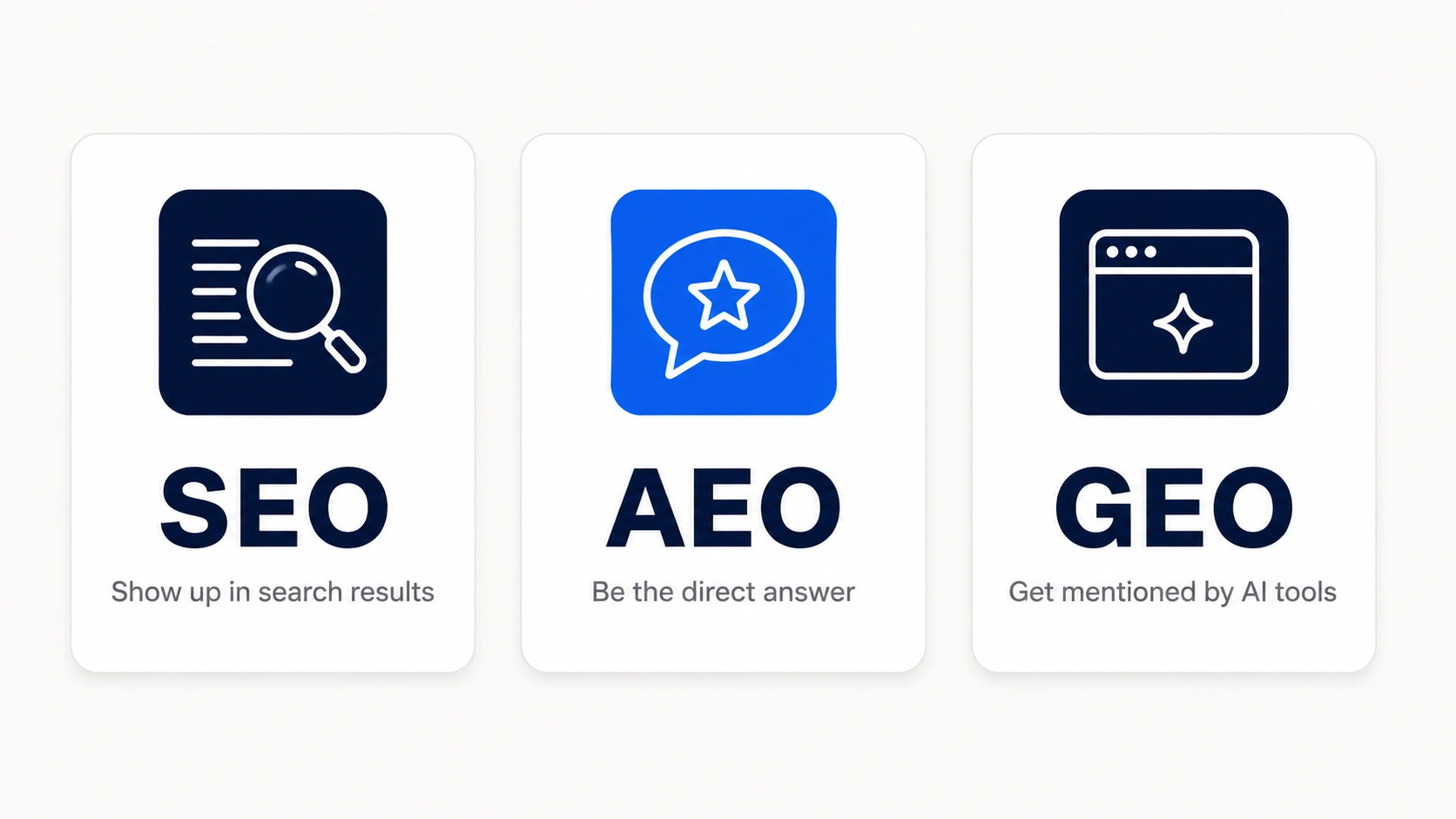
SEO is getting your website to show up when someone searches on Google. AEO is getting your content picked as the direct answer, the one that appears in an AI Overview box or gets read aloud by a voice assistant. GEO is getting your business mentioned inside AI tools like ChatGPT, Gemini, Claude and Perplexity when someone asks them a question.
Three names, three places people look for answers. That is genuinely all there is to it.
Here is the part most articles bury: these are not three separate jobs. They overlap enormously. If you do good, honest SEO, you are already doing most of the work for the other two. You do not need three budgets or three agencies. You mostly need to keep doing the same solid work, with a few small additions.
Below I will explain each one in plain words, show you where they genuinely differ, clear up a naming confusion that trips almost everyone up, and show you a real example from my own site so you can see what this looks like in practice.
The short answer, in one table
If you only read one thing, read this.
| SEO | AEO | GEO | |
|---|---|---|---|
| Full name | Search Engine Optimization | Answer Engine Optimization | Generative Engine Optimization |
| Where it shows up | The normal blue links on Google | AI Overview boxes, featured snippets, voice assistants | Inside ChatGPT, Gemini, Claude, Perplexity answers |
| What you want | A click to your website | To be quoted as the answer | To be mentioned and linked as a source |
| Main work | Keywords, site speed, links, useful pages | Clear headings, direct answers, FAQs, schema | Being genuinely known and trusted across the web |
| How you measure it | Rankings and traffic in Search Console | Whether you appear in the answer box | Ask the AI tools about your topic and see who they name |
Worth knowing: AEO and GEO are newer terms and people use them loosely. Some writers treat them as the same thing. Others split them exactly as I have above. Do not worry too much about the labels. Worry about whether people can find you in all three places.
What is SEO?
SEO is the oldest and most familiar of the three. It means making your website easy for search engines to find, read and trust, so that when someone types a question into Google, your page shows up.
Say someone in Sydney searches “emergency plumber near me.” SEO is all the work that decides whether a plumbing website appears in those results or sits invisible on page four.
In practice, SEO covers:
- Writing pages that genuinely answer what people are searching for
- Making sure Google can crawl and understand your site
- Keeping your site fast, especially on phones
- Earning links and mentions from other reputable websites
- Fixing the technical problems that quietly hold a site back
That last one matters more than people expect. A beautifully written page will not rank if the site is slow, blocked, or broken underneath. If you want to check your own site properly, I have written a full WordPress technical SEO checklist that walks through every item in order, including what you can safely ignore.
The goal of SEO is a click. Someone sees your link, clicks it, and lands on your site. Simple.
What is AEO?
AEO stands for Answer Engine Optimization. It is about being the answer rather than being one of the options.
Think about what Google looks like now. You search something and often you get a box at the top that just tells you the answer. You never click anything. Same when you ask your phone a question out loud and it reads a single reply back to you.
That box, and that spoken reply, have to pull their information from somewhere. AEO is the work of making sure that somewhere is you.
Usefully, Google has published its own advice on performing well in AI experiences, and none of it is exotic. Unique content, a good page experience, and making sure Google can actually access your pages.
What actually helps:
- Answer the question immediately. If your heading is “How long does a bathroom renovation take?”, the very next sentence should answer it. Do not warm up for three paragraphs first.
- Write the way people actually ask. People search “why is my website so slow” rather than “website performance degradation causes.”
- Use clear headings. One question per heading, answered underneath it.
- Add a real FAQ section where it genuinely fits, not stuffed onto every page.
- Add schema markup so machines can tell what kind of content they are looking at.
The goal of AEO is to be quoted. You may not always get the click, and that is the uncomfortable trade. But being named as the source builds recognition, and people who do click through tend to already trust you.
What is GEO?
GEO stands for Generative Engine Optimization. The term comes from a research paper published in November 2023 by researchers at Princeton, the Allen Institute for AI, Georgia Tech and IIT Delhi, and it caught on as AI chat tools became a normal way to look things up.
Here is the difference from AEO. AEO is mostly about answer boxes inside a search engine. GEO is about the AI tools themselves. When someone opens ChatGPT and types “who is a good WordPress developer for a small business site”, GEO is what decides whether your name comes up.
This one is harder, and I want to be honest about why: nobody outside those companies knows exactly how these models choose who to mention. Anyone who tells you they have cracked it is guessing.
What we can say with reasonable confidence, based on what these tools cite in practice:
- They favour sources that already exist in many places. If your business is only mentioned on your own website, you are a single data point. If you appear on LinkedIn, a directory, a client’s site, a forum thread and a review platform, you become a pattern.
- They like content that is easy to lift. Clear structure, plain claims, specific facts.
- They lean on consistency. If your business name, location and services are described the same way everywhere, there is nothing to contradict.
- Original material stands out. A real case study with real numbers is far more citable than another summary of what everyone else already wrote.
The goal of GEO is to be mentioned. Not ranked, not boxed. Named.
A quick warning about the name “GEO”
This trips up almost everyone, and I have not seen a single article mention it.
In marketing, “geo” has meant geographic for about twenty years. Geo-targeting. Geo-location. So when people hear “GEO optimization”, a lot of them reasonably assume it means local SEO, ranking in a particular city.
It does not. In this context GEO means Generative Engine Optimization and has nothing to do with location. If it is actually local visibility you are after, that is a different discipline, and I have covered it separately in how to rank higher on Google Maps.
If you hire someone and they start talking about GEO, ask them which one they mean before you agree to anything. I have seen this cause genuine confusion in sales conversations, in both directions.
The part nobody tells you: most of the work is the same
Read enough agency blog posts and you will come away thinking you now need three strategies and three invoices.
You do not.
Look at what each one actually needs, and you will notice the same items keep appearing:
| What you do | Helps SEO | Helps AEO | Helps GEO |
|---|---|---|---|
| Write genuinely useful, accurate content | Yes | Yes | Yes |
| Clear headings and structure | Yes | Yes | Yes |
| Fast, working, crawlable website | Yes | Yes | Yes |
| Schema markup | Some | Yes | Yes |
| Mentions and links from other sites | Yes | Some | Yes |
| Consistent business details everywhere | Yes | Yes | Yes |
| Answering questions directly and early | Some | Yes | Yes |
That is roughly eighty percent shared. The genuinely AEO-specific and GEO-specific work is a thin layer on top of good SEO, not a replacement for it.
So if you have been putting off SEO because you heard it is dying and AI is taking over, you have it backwards. The foundation matters more now, because it feeds all three.
What this looks like in practice
Let me show you something from my own site rather than talk in theory.
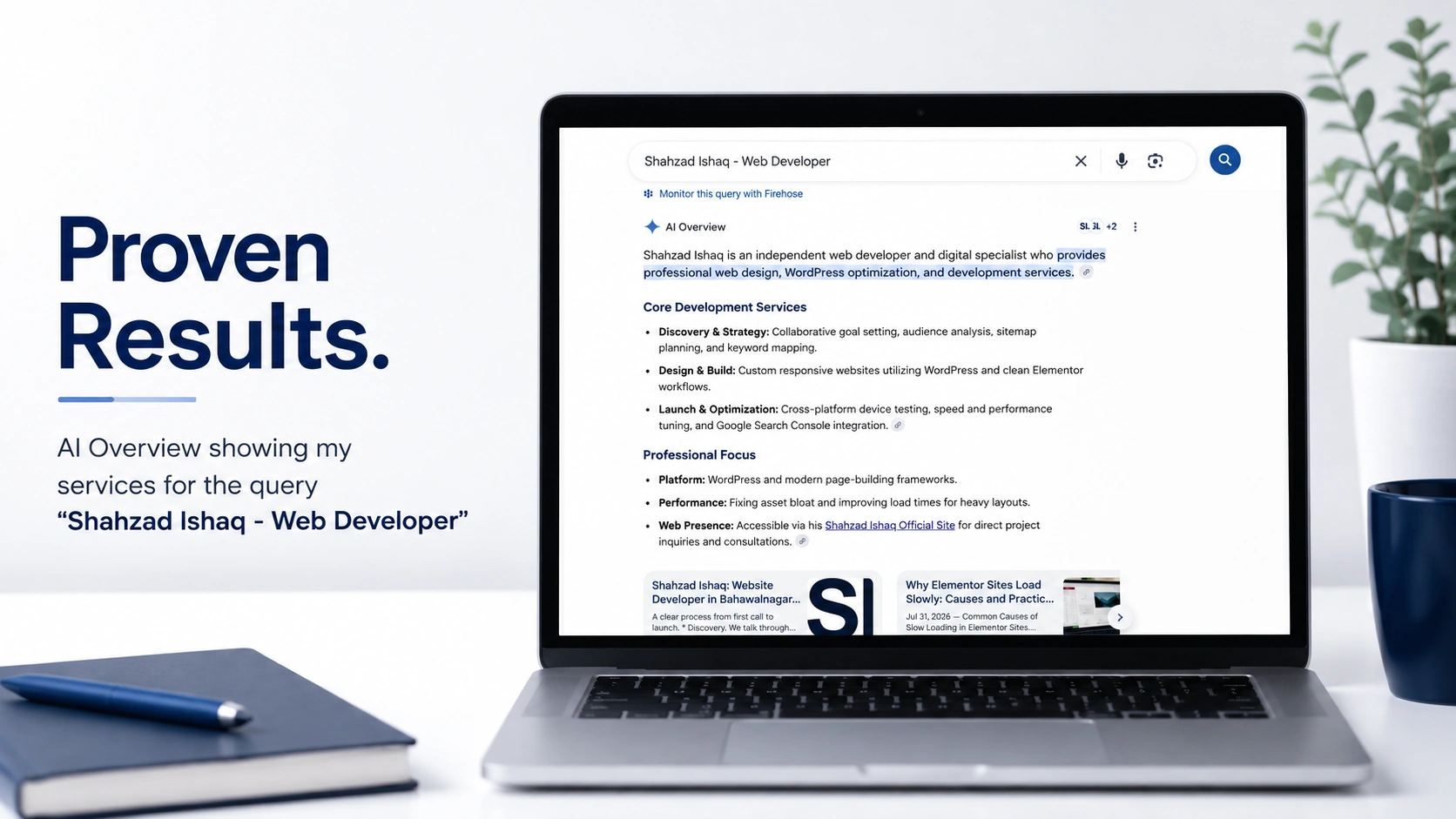
When someone searches my name and role, Google now generates an AI Overview that describes what I do, breaks down my services, and links to my site as the source. Underneath it, my blog articles are pulled in as supporting results.
I did not do anything exotic to make that happen. There is no AI trick involved. What existed was:
- A site that clearly and consistently states who I am, what I do and where I work
- Service pages that explain my actual process in plain language
- Blog articles answering real questions people ask me
- The same details repeated consistently across my profiles elsewhere
- Clean technical foundations so everything could be crawled properly
That is ordinary SEO work. The AI Overview is a by-product of it. Which is rather the point of this whole article.
Be realistic: this happens far more easily for a specific search like a business name than for a competitive one like “best web developer.” Getting cited for your own brand is achievable for almost anyone. Getting cited for a competitive commercial term is much harder and takes real authority.
What to actually do first
In the order I would genuinely tackle it.
1. Fix the foundations
Nothing else works if your site is slow, broken or accidentally blocking search engines. This is unglamorous and it is still the highest-value thing on the list. Work through the technical SEO checklist once, properly.
2. Answer real questions properly
Write down the ten questions clients actually ask you. Answer each one honestly on your site, with the answer near the top rather than buried. This single habit serves all three at once.
3. Make your details consistent everywhere
Same business name, same description, same services, wherever you appear online. Contradictions make you harder to trust, for people and machines alike.
4. Add schema where it fits
Organization details, articles, FAQs. Most SEO plugins handle this. Do not force an FAQ onto a page just to get the markup.
5. Get mentioned somewhere other than your own site
This is the hardest and most valuable. A profile, a directory, a guest article, a client case study, a genuine forum answer. Being known in more than one place is what separates a business that AI tools mention from one they have never encountered.
6. Then check where you stand
Search your business name in Google and look for an AI Overview. Ask ChatGPT and Perplexity about your field and see whether you come up. It is a rough check, not a metric, but it tells you something.
Three things people get wrong
“SEO is dead.” It is not. It is the foundation the other two are built on. Every AI answer has to source its information from somewhere, and that somewhere is still websites. Google says as much in its official guide to generative AI features, noting that normal SEO practices still apply because these features run on the same core ranking systems.
“You need special AI content.” No. Content written clearly and honestly for humans is exactly what these systems prefer. Writing “for the AI” produces the thin, generic material that gets ignored.
“You need a separate GEO tool or agency.” Not yet, and possibly not ever. The tools in this space are new and most measure things nobody can verify. Spend the money on genuinely better content and real credibility first.
The bottom line
SEO gets you found. AEO gets you quoted. GEO gets you mentioned.
They are three doors into the same room, and the way through all three is the same: be genuinely useful, be easy to understand, be technically sound, and be known somewhere beyond your own website.
If you do that, you do not need to chase every new set of letters that appears next year. And there will be more.
Frequently Asked Questions (FAQ)
Is SEO still worth doing in 2026?
Yes, and arguably more than before. AI answers have to pull their information from real websites. If your site is not crawlable, fast and useful, it does not become a source for anything. SEO is now the foundation for all three approaches rather than a separate tactic.
Does GEO mean geographic or local SEO?
No. In this context GEO means Generative Engine Optimization, which is about appearing inside AI tools like ChatGPT and Perplexity. It has nothing to do with location. The name is genuinely confusing, so it is worth clarifying which meaning someone intends before hiring them.
What is the difference between AEO and GEO?
AEO is mostly about being the direct answer inside a search engine, such as an AI Overview box, a featured snippet or a spoken voice reply. GEO is about being mentioned inside AI chat tools when someone asks them a question. There is overlap, and some people use the terms interchangeably.
Do I need to hire a separate agency for AEO and GEO?
In most cases no. Around eighty percent of the work is shared with ordinary SEO. Fix your technical foundations, answer real questions clearly, keep your business details consistent, and build genuine mentions elsewhere. Those actions serve all three at once.
How do I check whether AI tools mention my business?
Search your business name in Google and see whether an AI Overview appears. Then ask ChatGPT, Gemini or Perplexity a question about your field and see whether you are named. It is a rough check rather than a proper metric, but it gives you a starting point.
Does writing content specifically for AI help?
Not really. Content written clearly and honestly for people is exactly what these systems tend to prefer. Writing deliberately for machines usually produces thin, generic material, which is the kind of content that gets passed over.