

If you’re a plumber, electrician, or builder serving one suburb, you don’t need to rank nationally. You need to be the obvious choice when someone in your area searches “plumber near me.” Here’s the exact local SEO playbook for tradies who work a tight service area.
Most local SEO advice assumes you have a shopfront and a marketing team. Tradies usually have neither. You’re on the tools all day, and your “service area” might be five suburbs, not a city. The good news: ranking in a single suburb is one of the easiest SEO wins in existence, because your competitors are mostly doing nothing. Here’s what actually works, in priority order.
Table of Contents
- 1. Claim and Complete Your Google Business Profile
- 2. Get Reviews, Then Keep Getting Them
- 3. Build One Page Per Suburb You Serve
- 4. Fix Your NAP Consistency
- 5. Get Listed in the Directories That Matter
- 6. Make Your Website Fast and Call-Focused
- 7. Add Local Schema Markup
- 8. Earn a Few Local Links
- What to Ignore
- The 90-Day Plan
- Frequently Asked Questions (FAQ)
1. Claim and Complete Your Google Business Profile
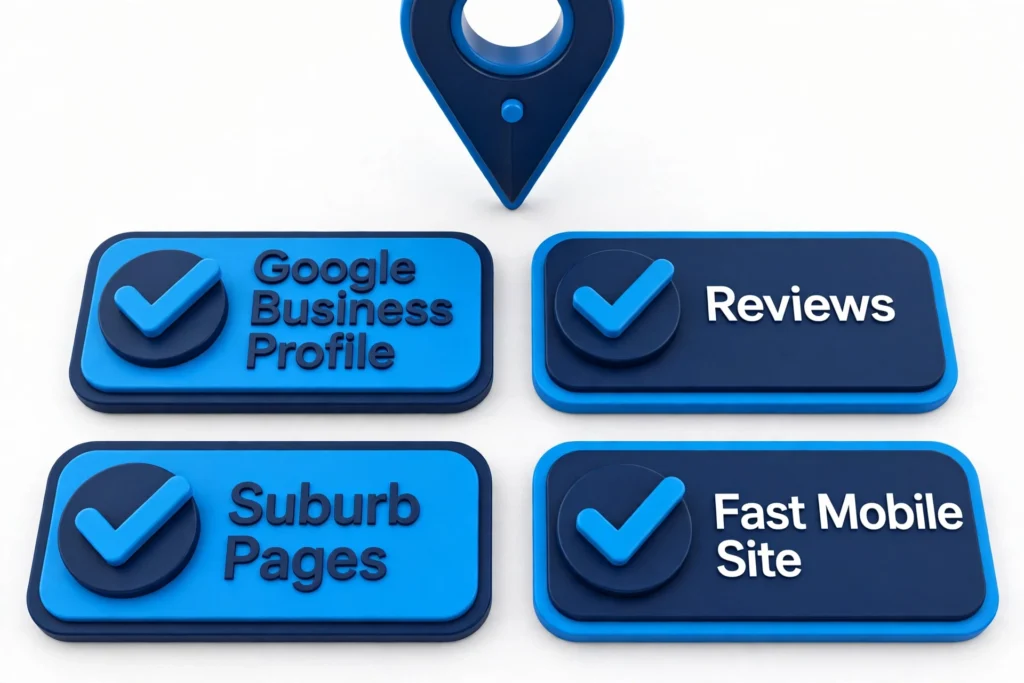
Your Google Business Profile (formerly Google My Business) is the single most important asset for local rankings. It powers the map pack, the box of three businesses that appears above organic results. Claim it, verify it, and fill in everything: correct trade category (“Plumber,” not “Plumbing Supply Store”), service areas listing your actual suburbs, opening hours, phone number, and a proper business description with your trade and area in natural language.
Add 10-20 real photos: your van, your team, finished jobs, before-and-afters. Businesses with photos get dramatically more calls, and most tradie competitors have three blurry photos from 2019. This alone can move you up the map pack. I go deeper on map rankings in how to rank higher on Google Maps in Australia.
When you add your website link to your profile, use the GBP UTM link builder to tag it so profile visits show up separately in your analytics.
2. Get Reviews, Then Keep Getting Them
Reviews are the heaviest-weighted local ranking factor you can directly influence, and they’re the first thing a homeowner checks before calling. The system that works: text every happy customer a direct review link the day the job finishes, while they’re still delighted. Aim for a steady flow: five new reviews a month beats fifty all at once, because Google trusts recency.
Respond to every review, good and bad. A calm, professional reply to a bad review impresses future customers more than the review itself damages you. Never buy reviews. Google removes them in waves, and a sudden purge looks worse than having few.
The review request that works
“Hi [name], glad the [job] is sorted! If you were happy with the work, a quick Google review would mean a lot to a small local business like ours. Here’s the link: [link]. Thanks!” Short, personal, sent same-day. Save it as a template on your phone.
3. Build One Page Per Suburb You Serve
This is the highest-ROI content play for a single-area tradie. Instead of one generic “Plumber” page, create dedicated pages: “Plumber in [Suburb],” “Emergency Electrician in [Suburb],” and so on. Each page should have genuinely local content: landmarks, common housing types, suburb-specific problems (“older weatherboard homes in [suburb] often have…”).
What not to do: create 30 near-identical pages with the suburb name find-and-replaced. Google treats that as thin content. Five to ten suburbs with real, distinct content beats thirty cookie-cutter pages. Include your service area in your Google Business Profile too, so the two reinforce each other.
4. Fix Your NAP Consistency
NAP (Name, Address, Phone) must be identical everywhere: your website, Google Business Profile, Facebook, and local directories. “Jim’s Plumbing” on your site and “Jims Plumbing Pty Ltd” on a directory are, to Google, two different businesses. Pick one format and use it everywhere. For tradies working from home, use a service-area listing (no public address) rather than publishing your home address.
5. Get Listed in the Directories That Matter

You don’t need 100 citations. You need the right ones. In Australia, that means True Local, Yellow Pages online, Yelp, and trade-specific platforms like hipages and Airtasker. Complete profiles with the same NAP, photos, and service descriptions. These directories rank well themselves, so they double as lead sources while reinforcing your local signals.
6. Make Your Website Fast and Call-Focused
Most tradie website visits are on mobile, from someone with an urgent problem. Your site needs to load fast and make calling frictionless: a sticky click-to-call button on mobile, your phone number in the header, a simple quote form, not a 12-field enquiry form. Every extra second of load time and every extra form field costs you jobs. I cover the technical side in how to speed up an Elementor site.
7. Add Local Schema Markup
Schema markup, specifically LocalBusiness schema with your trade type, service area, hours, and reviews, helps Google understand exactly what you do and where. If you use Rank Math or similar SEO plugins, most of this is a settings page, not code. It’s a small ranking factor but it powers rich details (ratings, hours) in your search listing that win clicks.
8. Earn a Few Local Links
You don’t need hundreds of backlinks. A handful of local ones beats dozens of generic ones. Sponsor the junior footy club (they’ll link your logo), join the local chamber of commerce, get listed by suppliers you use, and ask happy commercial clients for a testimonial link. Local relevance matters more than raw authority for suburb-level rankings.
What to Ignore
Blogging weekly about plumbing tips won’t rank you in your suburb. Nobody searches “how to fix a tap” and then hires you. Social media posting doesn’t directly affect rankings. And anyone selling you “guaranteed #1 on Google” is selling something Google explicitly says can’t be guaranteed. The eight steps above, done consistently, beat every shortcut.
The 90-Day Plan
| When | Do this |
|---|---|
| Week 1 | Claim and fully complete Google Business Profile; add 15+ photos |
| Week 2 | Fix NAP everywhere; list on 5 key directories |
| Week 3-4 | Build suburb service pages (one per area, real local content) |
| Ongoing | Review request after every job; respond to all reviews |
| Month 2 | Speed up the site; sticky call button; LocalBusiness schema |
| Month 3 | Chase 3-5 local links (sponsorships, suppliers, chamber) |
Most tradies see map-pack movement within 4-8 weeks of doing steps 1-3 properly, because the local competition is usually asleep. If you want help with any of this (profile setup, suburb pages, or a fast site that converts callers), I build SEO-ready websites for tradies and local businesses. Get in touch and tell me which suburb you’re targeting.
Frequently Asked Questions (FAQ)
How long does local SEO take for a tradie?
In a single suburb with weak competition, expect visible map-pack movement in 4-8 weeks and solid rankings in 3 months. Competitive metro areas take longer: 6+ months of consistent reviews and content.
Do I need a physical shop for local SEO?
No. Google Business Profile supports service-area businesses: you list the suburbs you serve instead of a public address. Most tradies operate this way.
Should I pay for Google Ads instead?
Ads buy instant visibility; SEO builds an asset that keeps producing leads without per-click costs. Most successful tradies run both: ads for immediate jobs while SEO compounds in the background.